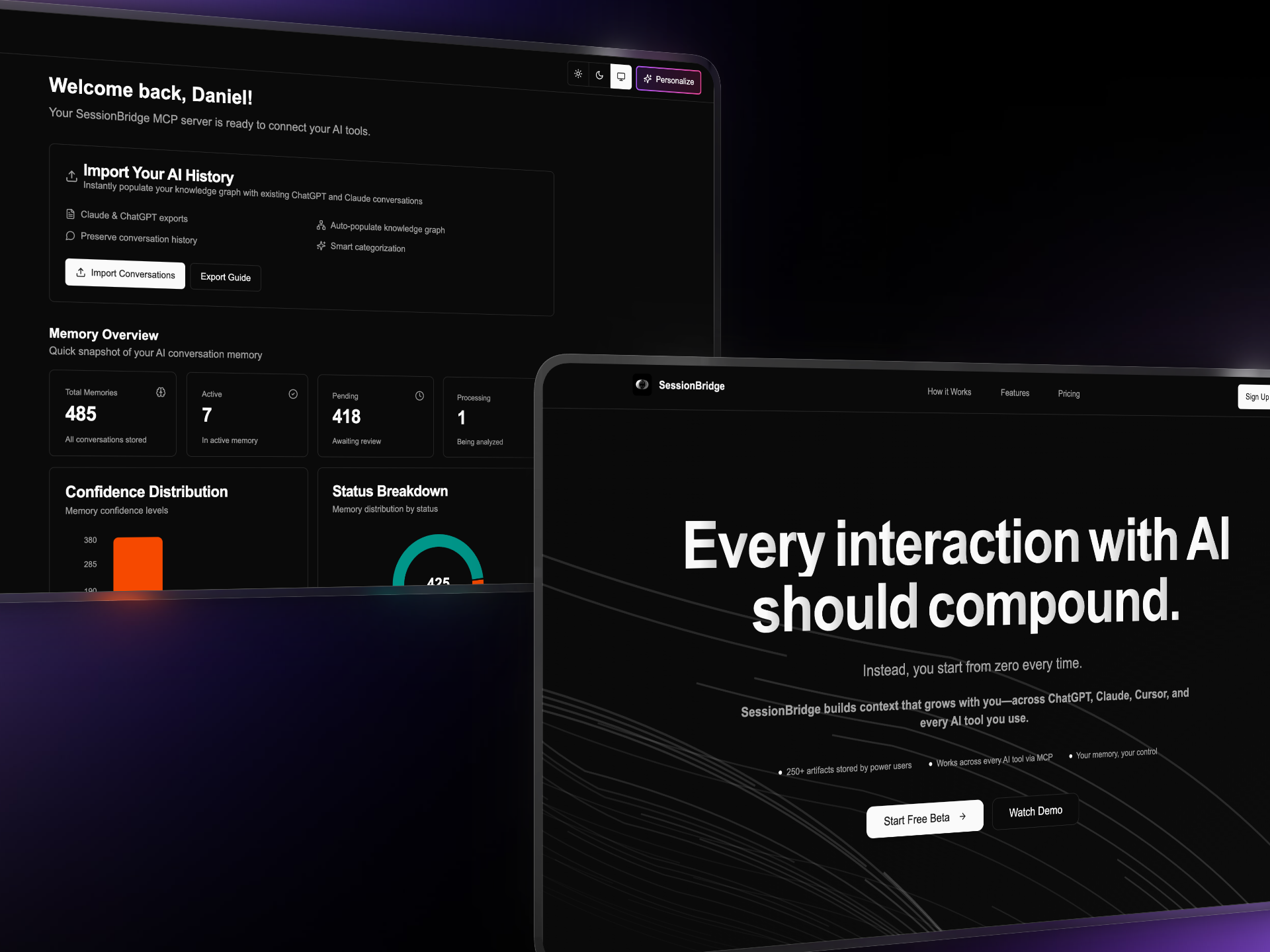
The Problem
Right now, your AI conversations don’t stack.
You’ve had thousands of conversations with AI. You’ve crafted hundreds of prompts. You’ve built context about your projects, preferences, and work.
- ChatGPT doesn’t know what you told Claude.
- Cursor doesn’t remember what you explained to ChatGPT.
- Even within the same tool, your best insights get buried.
You never see patterns across conversations. You can’t find that perfect prompt from last month. Every Monday, you start from zero—again.
Every interaction with AI should compound. Today, it doesn’t.
Origin
I built the first version of SessionBridge before most platforms had built‑in memory—purely to solve my own workflow. I was switching between Claude, ChatGPT, and Cursor all day and losing momentum. That personal pain shaped the initial scope: a lightweight MCP memory server and a single URL that follows me across tools. Early testers validated the pain and their feedback directly informed what the product has become.
Evolution Timeline
- V1: Personal MCP memory server with session persistence and a single URL to follow me across tools.
- Early feedback: Users wanted surfacing of reusable prompts and better retrieval across tools.
- V1.5: Added import of past conversations and a hybrid search proof‑of‑concept.
- V2: Introduced Weekly Digest, Prompt Discovery, and temporal linking to show how ideas evolve.
- Today: Cross‑platform memory graph used across ChatGPT, Claude, Cursor; 250+ artifacts, 44+ conversations.
- Next: Automatic capture, temporal invalidation, prompt versioning, cross‑tool analytics.
Role and Skills
- Problem discovery from personal workflow, then validation with early users
- Rapid prototyping: concept to working build in 3 days
- Protocol integration: MCP to unify memory across tools
- Backend architecture on Xano: APIs, session persistence, semantic retrieval
- Data modeling: memory graph and temporal linking
- Product iteration: user interviews drove Weekly Digest and Prompt Discovery
- DX/UX: import flows, hybrid search, digest emails
- Analytics: artifact and conversation tracking to verify compounding behavior
What I Built
I built SessionBridge to make context compound instead of reset. The project started as an MCP server with session persistence and evolved—driven by user feedback—into a memory layer that also surfaces insights and temporal patterns.
SessionBridge: Context That Compounds
Memory that accumulates. Insights that surface. Context that connects.
Your Memory Accumulates
I implemented cross-tool capture via MCP so context persists across ChatGPT, Claude, Cursor, and more. Power users have stored 250+ artifacts across 44+ conversations in a single memory graph—context stacks instead of resets.
Your Insights Surface
Based on user interviews, I added a Weekly Digest that automatically surfaces the 5 most reusable prompts and key artifacts. The prompt you perfected Tuesday becomes reusable by Friday—no digging required.
Your Patterns Connect
I designed temporal linking to show how thinking evolves across conversations—what you said, when it mattered, and how it connects to what came next.
Key Implementation Decisions
Highlights of what I built to enable compounding context across AI tools.
- Weekly Digest: Auto-summarizes the week’s most reusable prompts, key artifacts, and patterns.
- Prompt Discovery: Surfaces the 10 most reusable prompts; one-click copy for reuse/versioning.
- Cross-Platform Memory: One memory graph across Claude Desktop, Cursor, ChatGPT, Windsurf.
- Smart Search: Hybrid AI search across conversations and artifacts; see how ideas evolved.
- Artifact Library: Stores code, docs, research with links back to their originating context.
- Import Past Conversations: ChatGPT and Claude import to bootstrap compounding from day one.
Architecture
High‑level flow from MCP clients to the memory graph and retrieval surfaces.
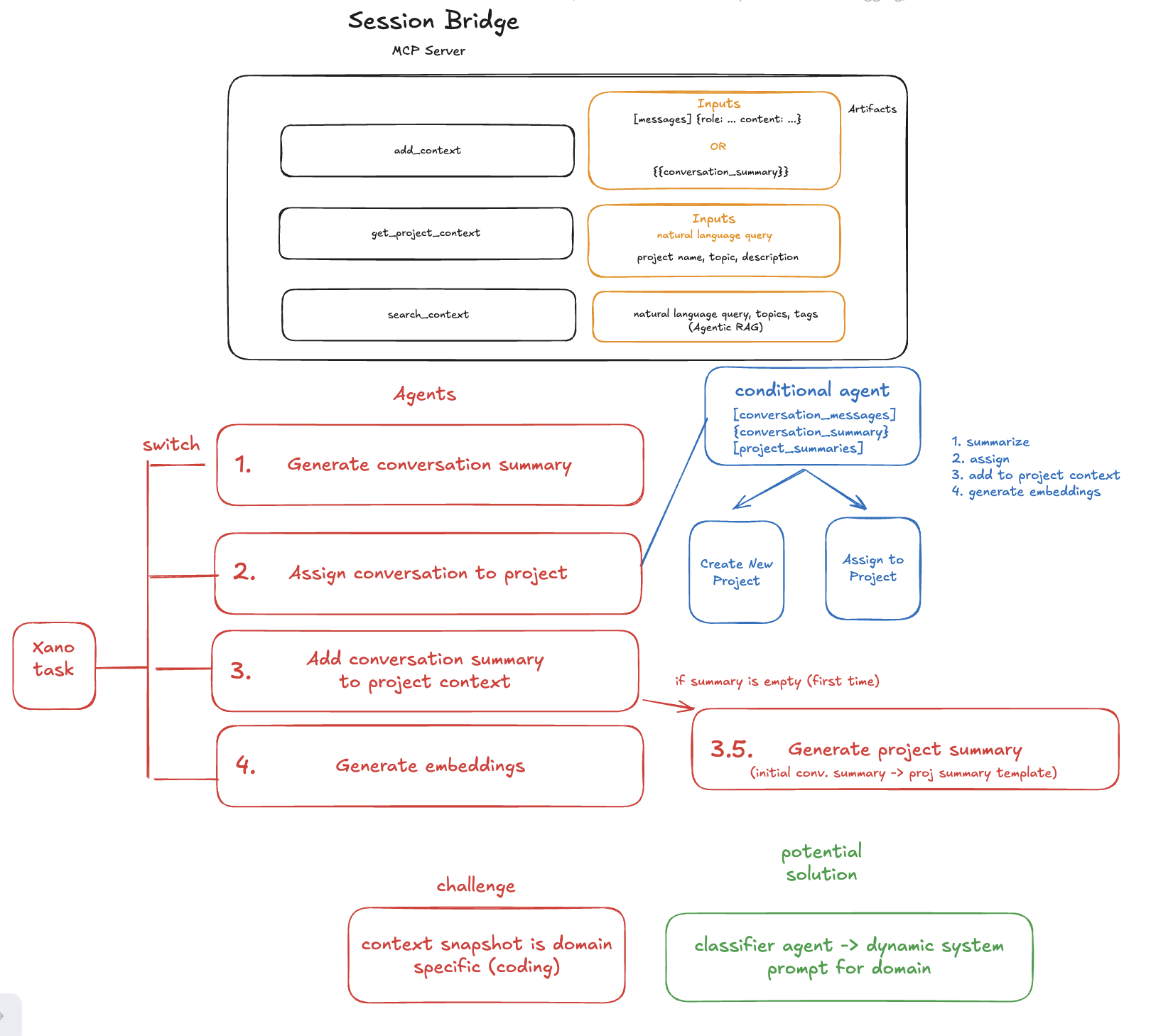
The diagram illustrates cross‑tool capture via MCP, session persistence, semantic retrieval, and surfaces like Weekly Digest and Prompt Discovery.
Technical Direction
Compounding requires continuity. AI tools will change. New models will launch. Platforms will evolve. Your memory shouldn’t break every time that happens.
SessionBridge is built to evolve with the AI landscape—using best-in-class techniques at each stage so your context keeps compounding regardless of which tools you’re using tomorrow. We’re not building for today’s tools—we’re building the memory layer that works with tomorrow’s tools too.
Next Iterations
- Automatic capture: Passive collection without user action
- Temporal invalidation: Understand when facts become outdated
- Prompt versioning: Track how your prompts evolve over time
- Cross-tool analytics: See how your AI usage patterns develop
User Feedback and Signals
- 250+ artifacts stored by power users over months — validation that compounding behavior emerges.
- 44+ conversations tracked for a single project — evidence of connected context vs. isolated chats.
- “Prompts are more valuable than outputs. Prompts should be saved and versioned.” — Preston
- “I want a complete canonical history of my prompts. I often redo work because finding it takes longer than recreating.” — Mark
Technical Approach
- Backend: Built on Xano for rapid development and robust API infrastructure
- Protocol: Model Context Protocol (MCP) as the standardized interface between AI tools and memory storage
- Architecture: Session-based memory persistence with semantic retrieval
- Integration: Single-URL access across all MCP-compatible clients
Shipped in 3 Days
From concept to working prototype in just three days. The speed came from leveraging Xano’s visual backend development capabilities combined with MCP’s clean abstraction layer. I iterated publicly through Dev.to, Substack, and X/Twitter, sharing learnings in real-time as I built.
Key Outcomes
- Demonstrated AI memory as a standalone product category, separate from basic RAG
- Attracted attention from the MCP and AI memory communities
- Became the foundation for my Dev.to article: “The Hidden Bottleneck in AI Development (and How We Removed It)”
- Informed multiple Substack pieces on agents and AI development tools
What I Learned
Most “AI problems” are actually backend and memory problems. The bottleneck in AI product development isn’t model quality—it’s infrastructure. When you treat memory as a first-class system rather than an afterthought, AI tools become true collaborators instead of stateless question-answering machines.
MCP is a powerful abstraction layer for cross-tool AI experiences, and the future of AI UX will be built on standards like this that enable context portability.